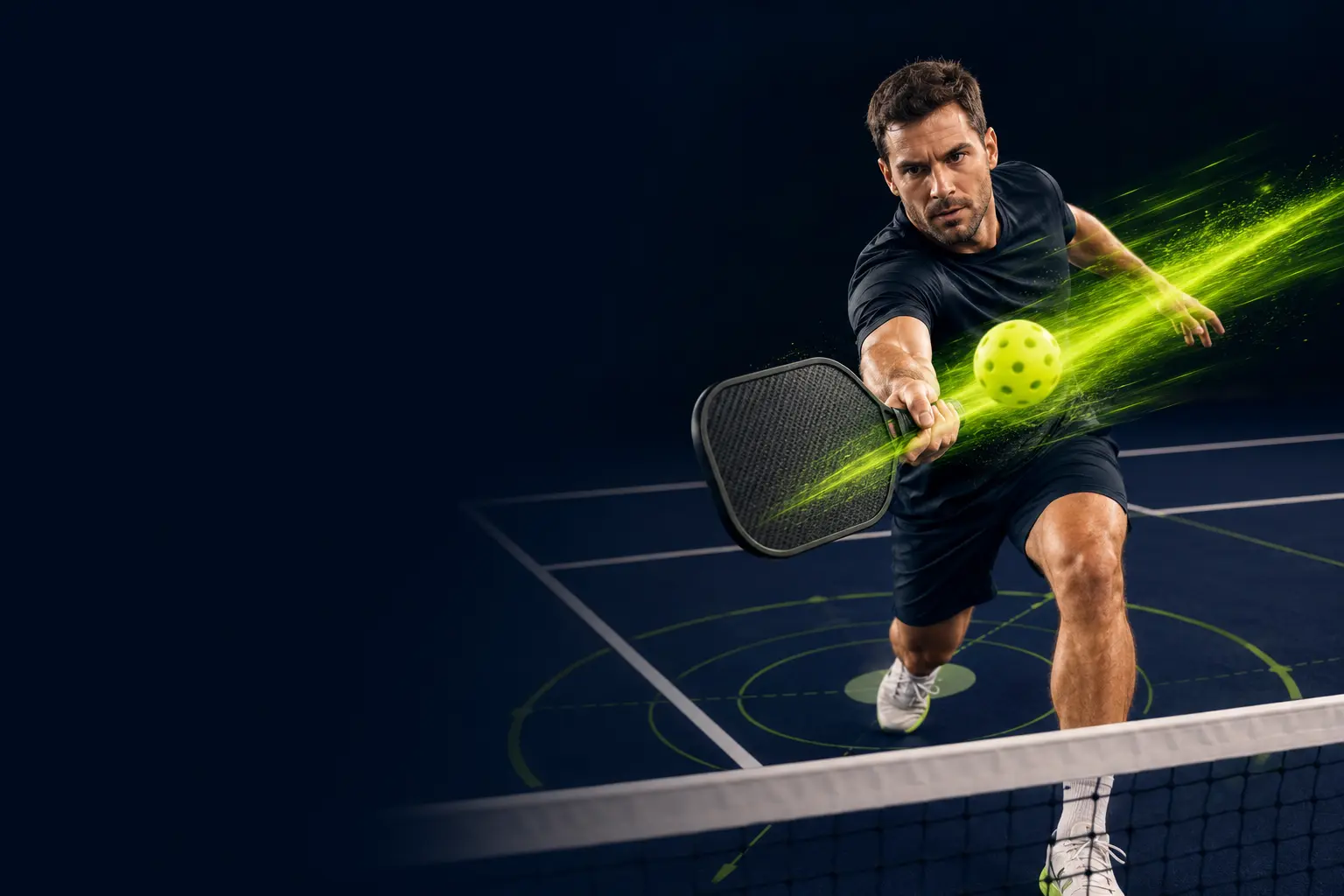
QUICK START
The essentials at a glance
- Attack a ball you can contact in front and near net height.
- Choose a target before starting the swing.
- Use compact acceleration instead of a large backswing.
- Expect a counter and recover the paddle immediately.
- Dink again when you are reaching or off balance.
Green light: the ball is above net height
A ball above the net lets you hit forward or slightly downward. That is a much safer attack than trying to lift a low ball while also adding pace.
Stay compact. Aim at open space, the dominant-side hip, or the opponent's feet. Placement gives your partner a predictable next ball and keeps the attack inside the court.
Green light: your opponent is off balance
Watch the player, not just the ball. An opponent who is moving, reaching, or recovering from the sideline has less time and a smaller range of responses.
Speed up behind a moving player or into the space they just left. You are using their movement to make the attack effective.
Yellow light: the ball is low but attackable
A low attack can work when you are balanced and the ball is in front, but it needs a clear purpose. Roll it with shape rather than hitting flat and hoping.
If you cannot identify the target before contact, dink again. Waiting one more ball is often the highest-percentage play.
- Attack from a stable base.
- Keep the backswing hidden and compact.
- Expect the ball to come back faster.
Red light: you are reaching or moving backward
Speeding up while off balance usually produces a ball that is high, wide, or easy to counter. Reset your position before trying to create offense.
The same rule applies when your partner is still moving forward. A premature attack can expose their feet before the team is ready for a hands battle.
Plan the next ball
A speed-up starts an exchange. It rarely ends one by itself. Keep your paddle up, stay connected with your partner, and expect a counter toward the middle or your backhand side.
A smart attack is one that leaves you ready for the reply. If the first shot is fast but your recovery is slow, the advantage disappears.
Pick a target with a purpose
The dominant-side hip or paddle-side shoulder can create an awkward decision between forehand and backhand. The body is useful when you want to reduce an opponent's angles. Open court is best when movement has already created a clear gap.
In doubles, avoid attacking randomly through the middle if both opponents are balanced and ready. Instead, identify the player who is moving, has a low paddle, or is less comfortable countering. Your target should make the next ball more predictable for your team.
Forehand roll, backhand flick, or simple push?
A forehand roll uses a compact low-to-high path to add topspin and bring a lower attack down into the court. A backhand flick can disguise acceleration from a dink-ready position. Both require stable contact and should be developed after a dependable straight-ahead speed-up.
For most improving players, a compact push through a high ball is the safest first attack. It is easier to control, easier to disguise, and easier to recover from than a large swing.
How to recognize the opponent's counter
After speeding up, read the opponent's paddle face. An open face often sends the ball upward or resets it. A closed, firm face suggests a counterattack. Keep your paddle centered and avoid dropping it after your first swing.
Protect the middle with your partner and expect the fastest reply to come toward the body. Use a short block when the counter is below your best strike zone. Trying to win two consecutive attacks from poor contact positions is a common way to lose the exchange.
Partner positioning before an attack
Do not start a hands battle while your partner is several feet behind you unless the ball is an obvious putaway. The closer player will be targeted, and the deeper player has less time to react at their feet.
When both partners are established at the kitchen, a speed-up is easier to support. Stay connected, avoid leaving a large middle gap, and agree on which player takes balls through the center.
A three-stage speed-up drill
Stage one is recognition: one player feeds dinks at different heights, and the attacker says 'go' or 'no' before contact. Stage two adds placement: attack only high balls toward a large body or hip target. Stage three becomes live: begin with four dinks, then play out the point.
Score decision quality separately from rally results. Give yourself one point for attacking the correct ball and one point for recovering in time for the counter. This prevents lucky winners from rewarding poor choices.
- Start at 60 percent pace.
- Attack only from balance.
- Freeze after the exchange and check your paddle position.
THE TAKEAWAY
Attack balls that are high, in front, and connected to a clear target. Stay patient when you are reaching, moving backward, or attacking only because the rally feels too slow.
READER QUESTIONS
Frequently asked questions
What is a speed-up in pickleball?
A speed-up is a deliberate increase in pace, usually from a dink exchange near the kitchen, intended to start an offensive exchange or force a weak reply.
How high should the ball be before I speed it up?
The safest attacks are contacted in front at or above net height. Skilled players can roll lower balls, but if the paddle must lift sharply upward, the attack is easier to counter or hit out.
Where is the best place to aim a pickleball speed-up?
Useful targets include the dominant-side hip, the body, the feet of a moving player, or open space created by movement. Choose the target before beginning the swing.
Should I speed up down the middle?
The middle can create confusion, but it is not automatically the best target. If both opponents are balanced with paddles ready, a body or moving-player target may produce a more predictable reply.
Why do my speed-ups go out?
Common causes are attacking from below net height, using too large a backswing, contacting late, and trying to create maximum pace. Use a compact path, contact in front, and add topspin when appropriate.
What should my partner do when I speed up?
Your partner should be established near the kitchen, connected to you laterally, paddle up, and ready to cover the middle or the most likely counterattack.
How do I disguise a speed-up?
Use the same preparation you use for a dink, keep the backswing small, and accelerate late. Obvious paddle takeback gives opponents time to prepare.
When should I never speed up?
Avoid it when reaching, moving backward, contacting well below the net, recovering from a wide ball, or when your partner is not ready for the faster exchange.
Helpful official resources
Rules and terminology can change. These current USA Pickleball resources provide additional official guidance.
Equipment for this practice
Use a comfortable paddle, a consistent ball model, and safe targets. Keep the same equipment while you work on the cue so you can judge the change in technique. Our pickleball gear buying guide explains paddle fit, indoor and outdoor balls, court shoes, and what to check before buying.
WHY YOU CAN USE THIS
How this guide was built
This guide turns official rules, established terminology, and common on-court situations into practical decisions and measurable practice. It is reviewed when governing guidance or a material recommendation changes.
Read our research, sourcing, and correction standards